
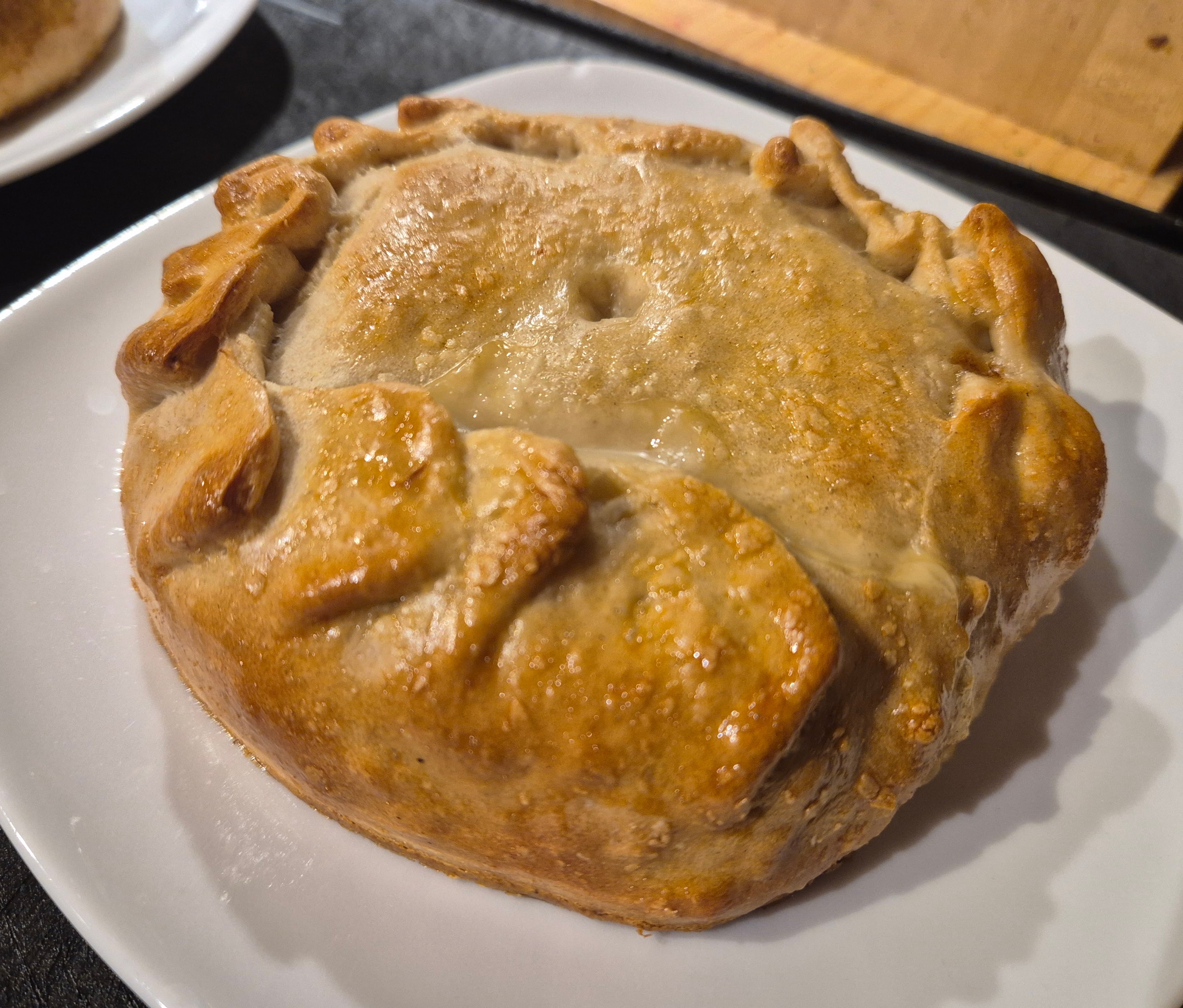
Original recipe
Diz heizzent heidenisse kuochen. Man sol nemen einen teyc vnd sol duenne breiten. vnd nim ein gesoten fleisch vnd spec gehacket vnd epfele vnd pfeffer vnd eyer dar in. vnd backe daz vnd gibes hin vnd vnd versirtez niht.
Translation
This is called a heathen cake. Take some dough and roll it out thinly. Then add cooked meat, chopped bacon, apples, pepper, and eggs and bake it. Serve and do not damage it.
Recreation and experience report
This recipe is very similar to the “fladen” in the second part of the Buch von Guter Speise. However, this is most likely to be understood as a pie, i.e., a kind of covered flatbread. This is indicated by the name “cake” and also by the fact that the filling is added ‘inside’ rather than “on top.” Unfortunately, it does not describe how the thinly rolled dough becomes a cake. At least it points out that it should not be damaged, so it should probably be served whole and decorated.

But other things also leave room for interpretation: First, should the filling be coarse or finely chopped? Only the bacon is explicitly chopped in the recipe. So I tried both and liked the finely chopped version much better, as the sweetness of the apple was better distributed and therefore more pleasant.
Then, which meat should you use? I chose pork, as it goes well with apple. Poultry should also work well. Since the meat is already cooked when added to the filling, this recipe is also ideal for using up leftovers.


The dough is not described in detail either, but this is a problem throughout the book. Most of the time, you don’t get any more information than “thin” or “coarse.” That’s why you can use any flour you like. This time, I used wheat and rye flour in a 1:1 ratio, as rye flour gives the dough a slightly more rustic flavor. You could use sourdough or yeast as a leavening agent. Both were well known and yeast in particular was readily available, as it is a by-product of beer brewing.

This recipe was another one that was fun to make and introduced me to a new flavor combination. The apple in the filling adds a pleasant juiciness and the sweetness harmonized well. However, the apple should be rather tart, as it can easily become too sweet.
The leftovers were also very tasty the next day and can be eaten cold. This makes these pagan cakes a great snack to take with you on hikes.

Ingredients
Method
- Knead the flour, water, yeast, salt, and oil into a dough and let it rise for about 1 hour.
- Cook the meat: Either in a pressure cooker (45 minutes with 300 ml of water) or in a saucepan (simmer for 1.5 hours or until tender). Allow to cool slightly. Alternatively, use meat cooked the day before.
- Preheat the oven to 180°C fan oven.
- Prepare the filling in a bowl: peel the apple, remove the core and cut into small pieces. Chop the bacon and add to the bowl. Tear the meat into small pieces and add to the bowl. Mix in one egg. Season with salt and pepper.
- Optional but recommended: chop the mixture a little more in a food processor or chop everything together with a knife.
- Divide the dough into two equal parts and roll out. Cut into rounds and roll out the sections again into smaller discs. Place half of the filling on the larger dough discs and place the small discs on top. Fold up the edges to seal the pie. Make a small hole in the middle.
- Beat the other egg and brush it onto the pies. Bake at 180°C for about 20 minutes.
Leave a Reply